フローチャートの練習
レンダリング結果
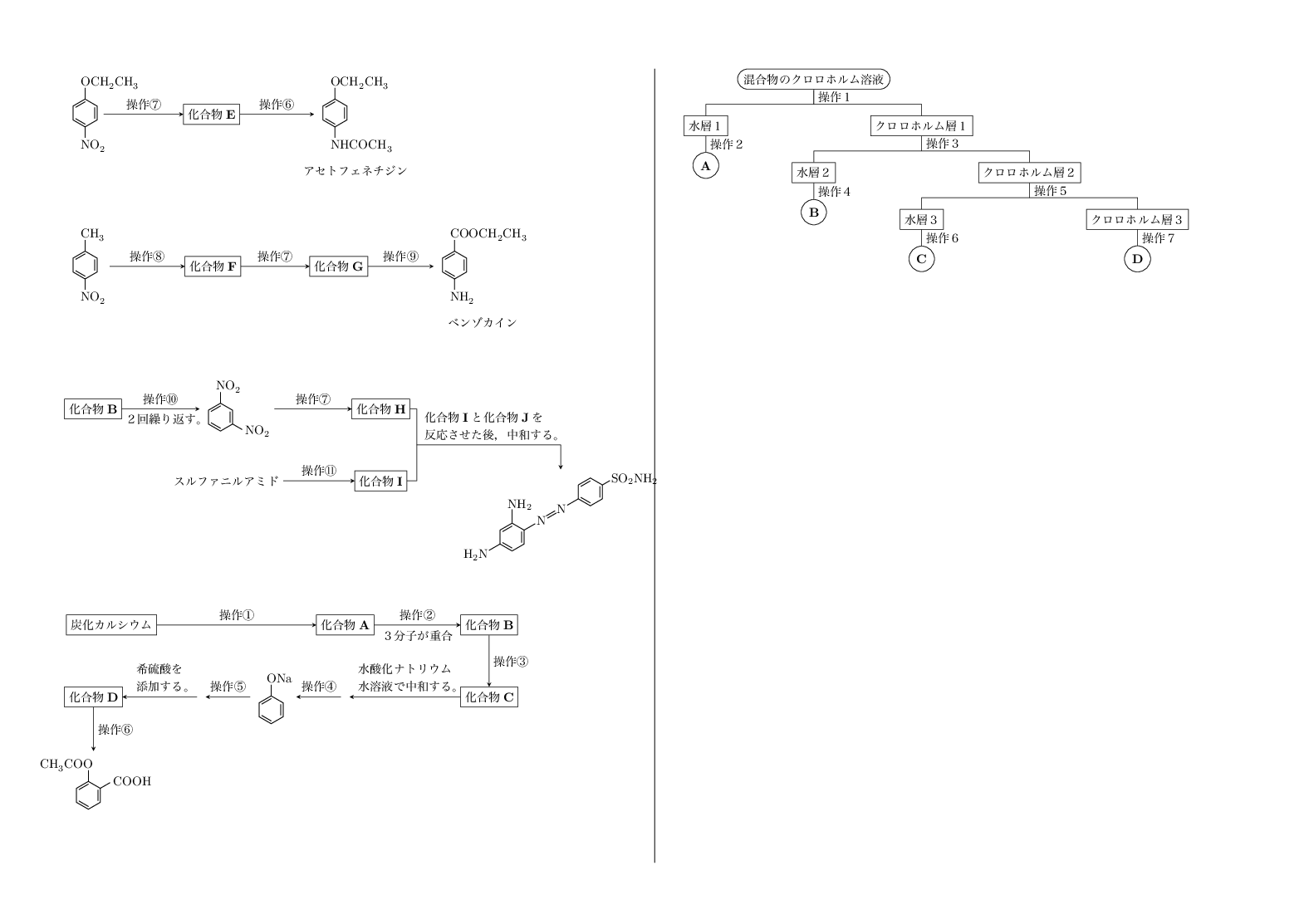
TeXソース
TeXソース
入力コード
\documentclass[b4j,landscape,10pt,twoside,twocolumn]{tetsujsarticle}
\usepackage{tetsuchem}

\begin{document}

\begin{tikzpicture}[>=stealth]
\node[rectangle,draw] (E) at (3,0) {化合物\bf{E}};
\node[label=below:アセトフェネチジン] (F) at ($(E)+(4,0)$) {\pphenyl*{OCH2CH3}{NHCOCH3}};
\draw[->] (0,0) node {\pphenyl*{OCH2CH3}{NO2}} -- node[above] {操作⑦} (E);
\draw[->] (E) --node[above] {操作⑥} (F);
\end{tikzpicture}

\br2

\begin{tikzpicture}[>=stealth]
\node (E) at (0,0) {\pphenyl*{CH3}{NO2}};
\node[rectangle,draw] (F) at ($(E)+(3.5,0)$) {化合物\bf{F}};
\node[rectangle,draw] (G) at ($(F)+(3.5,0)$) {化合物\bf{G}};
\node[label=below:ベンゾカイン] (H) at ($(G)+(4,0)$) {\pphenyl*{COOCH2CH3}{NH2}};
\draw[->] (E) --node[above] {操作⑧} (F);
\draw[->] (F) --node[above] {操作⑦} (G);
\draw[->] (G) --node[above] {操作⑨} (H);
\end{tikzpicture}

\br2

\begin{tikzpicture}[>=stealth]
\node[rectangle,draw] (B) at (0,0) {化合物\bf{B}};
\node (C) at ($(B)+(4,0)$) {\mphenyl{NO2}{NO2}};
\node (D) at ($(C)+(-.3,-2)$) {スルファニルアミド};
\node[rectangle,draw] (H) at ($(C)+(4,0)$) {化合物\bf{H}};
\node[rectangle,draw] (I) at ($(H)+(0,-2)$) {化合物\bf{I}};
\coordinate (J) at ($(H)+(1,0)$);
\coordinate (K) at ($(I)+(1,0)$);
\coordinate (L) at ($(J)!.5!(K)$);
\coordinate (M) at ($(L)+(4,0)$);
\node (N) at ($(M)+(0,-2)$) {\benzenefig{*6((-[,1.4]H_2N)=-=(-[,1.4]N=[:30,1.7]N-[:30,1.4]*6(=-=(-SO_2NH_2)-=-))-(-[,1.4]NH_2)=-)}};
\draw[->] (B) --node[above] {操作⑩} node[below] {2回繰り返す。} (C);
\draw[->] (C) --node[above] {操作⑦} (H);
\draw[->] (D) --node[above] {操作⑪} (I);
\draw (H) -- (J) -- (K) -- (I);
\draw (L) --node[above,align=left] {化合物\bf{I}と化合物\bf{J}を\\[-2pt]反応させた後,中和する。} (M);
\draw[->] (M) -- (N);
\end{tikzpicture}

\br2

\begin{tikzpicture}[>=stealth]
\node[rectangle,draw] (CaC2) at (0,0) {炭化カルシウム};
\node[rectangle,draw] (A) at ($(CaC2) + (6.5,0)$) {化合物\bf{A}};
\node[rectangle,draw] (B) at ($(A) + (4,0)$) {化合物\bf{B}};
\node[rectangle,draw] (C) at ($(B) + (0,-2)$) {化合物\bf{C}};
\node (C1) at ($(C) + (-4,0)$) {};
\node (C2) at ($(C1) + (-2,0)$) {\phenyl*{ONa}};
\node (C3) at ($(C2) + (-2,0)$) {};
\node[rectangle,draw] (D) at ($(C3) + (-3,0)$) {化合物\bf{D}};
\coordinate (E) at ($(D) + (0,-1.5)$);
\node (F) at ($(E)+(.5,-1)$) {\ophenyl*{\hamidasi(7pt,0pt)[R]{\ce{CH3COO}}}{COOH}};
\draw[->] (CaC2) --node[above]{操作①} (A);
\draw[->] (A)    --node[above]{操作②} node[below]{3分子が重合} (B);
\draw[->] (B)    --node[right]{操作③} (C);
\draw[->] (C)    --node[above,align=left]{水酸化ナトリウム\\[-2pt]水溶液で中和する。} (C1);
\draw[->] (C1)   --node[above]{操作④} (C2);
\draw[->] (C2)   --node[above]{操作⑤} (C3);
\draw[->] (C3)   --node[above,align=left]{希硫酸を\\[-2pt]添加する。} (D);
\draw[->] (D)    --node[right]{操作⑥} (E);
\end{tikzpicture}


\newpage


\begin{tikzpicture}
\node[rounded rectangle,draw] (c0) at (3,0) {混合物のクロロホルム溶液};
\node[rectangle,draw] (w1) at (0,-1.3) {水層1};
\node[circle,draw] (A) at (0,-2.4) {\bf{A}};
\node[rectangle,draw] (c1) at (6,-1.3) {クロロホルム層1};
\coordinate (水層1の上) at  ($(w1)+(0,0.6)$);
\coordinate (クロロホルム層1の上) at  ($(c1)+(0,0.6)$);
\node[rectangle,draw] (w2) at (3,-2.6) {水層2};
\node[circle,draw] (B) at (3,-3.7) {\bf{B}};
\node[rectangle,draw] (c2) at (9,-2.6) {クロロホルム層2};
\coordinate (水層2の上) at ($(w2)+(0,0.6)$);
\coordinate (クロロホルム層2の上) at ($(c2)+(0,0.6)$);
\node[rectangle,draw] (w3) at (6,-3.9) {水層3};
\node[circle,draw] (C) at (6,-5) {\bf{C}};
\node[rectangle,draw] (c3) at (12,-3.9) {クロロホルム層3};
\coordinate (水層3の上) at ($(w3)+(0,0.6)$);
\coordinate (クロロホルム層3の上) at ($(c3)+(0,0.6)$);
\node[circle,draw] (D) at (12,-5) {\bf{D}};
\draw (w1) -- (水層1の上) -- (クロロホルム層1の上) -- (c1);
\draw (c0) --node[right] {操作1} (c0 |- 水層1の上);
\draw (w1) --node[right] {操作2} (A);
\draw (w2) -- (水層2の上) -- (クロロホルム層2の上) -- (c2);
\draw (c1) --node[right] {操作3} (c1 |- 水層2の上);
\draw (w2) --node[right] {操作4} (B);
\draw (w3) -- (水層3の上) -- (クロロホルム層3の上) -- (c3);
\draw (c2) --node[right] {操作5} (c2 |- 水層3の上);
\draw (w3) --node[right] {操作6} (C);
\draw (c3) --node[right] {操作7} (D);
\end{tikzpicture}


\end{document}